

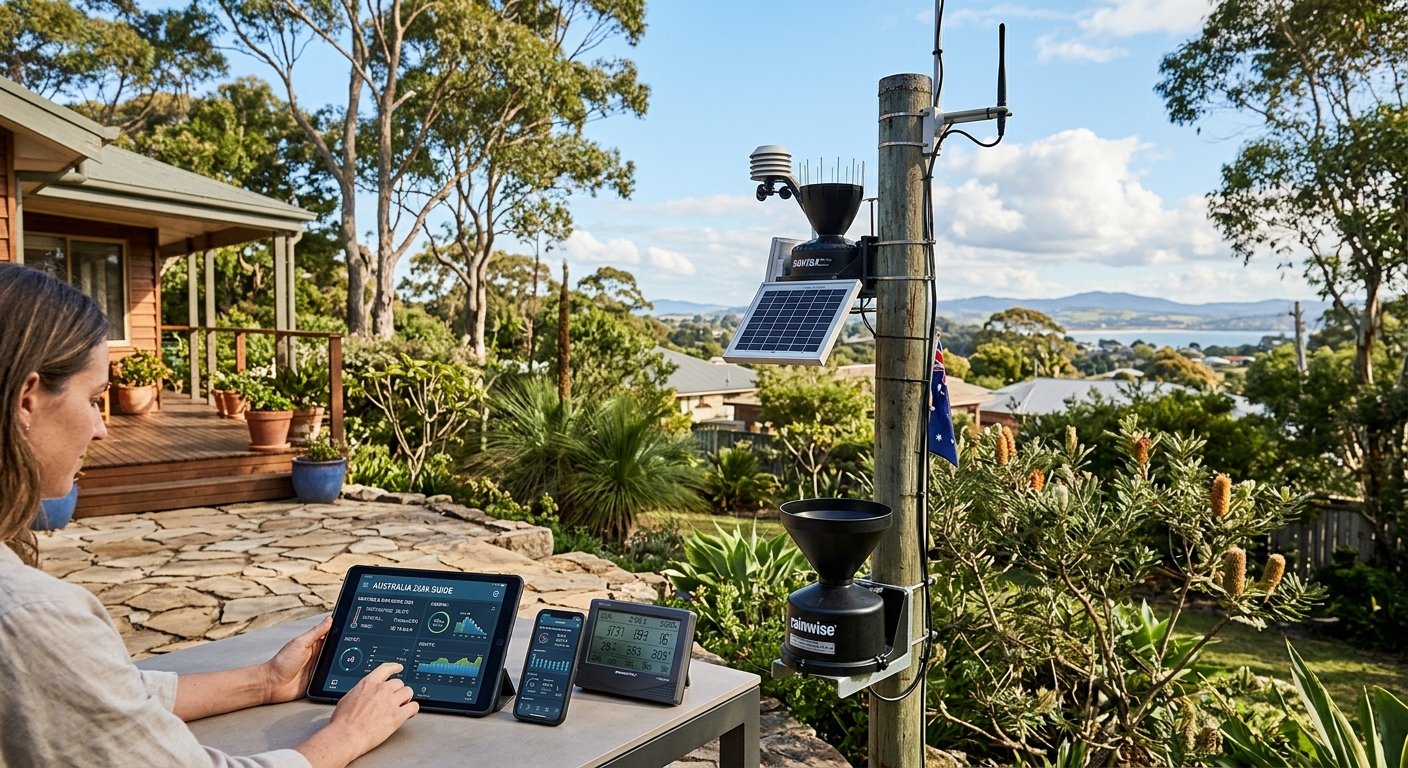
Track local temperature, humidity, UV index, and rainfall right from your backyard. Explore our top-rated wireless home weather stations and digital rain gauges available across Australia—reviewed for sensor accuracy and smart connectivity.
Quick Comparison: Top Home Weather Stations & Rain Gauges in Australia
| Weather Station Model | Sensor Array Type | Smart Connectivity | Key Metrics Tracked | Best For |
|---|---|---|---|---|
| Ecowitt Wittboy GW2001 (WS90) | 7-in-1 Ultrasonic / Haptic Sensor | Wi-Fi + App + Weather Underground | Temp, Humidity, Wind, UV, Solar, Haptic Rain | Zero moving parts & modern smart home tracking |
| Ambient Weather WS-2902 Osprey | All-in-One Solar Sensor Suite | Wi-Fi + Ambient Weather Network | Temp, Humidity, Wind Speed/Dir, UV, Rainfall | Detailed backyard data & smart home integration |
| La Crosse Technology V40-PRO-INT | Modular Wind + Rain + Thermo Sensors | Wi-Fi + AccuWeather Forecast | Indoor/Outdoor Temp, Wind, Rainfall, Barometer | Bright indoor color console & easy setup |
| Ecowitt WH5360B Digital Rain Gauge | Wireless Self-Emptying Tipping Bucket | Standalone Indoor LCD Console | Daily/Weekly/Monthly Rainfall + Indoor Temp | Gardeners & rainwater tank owners on a budget |
| Davis Instruments Vantage Vue | Heavy-Duty Integrated Sensor Suite | Wireless Console (Optional WeatherLink) | Pro-grade Temp, Wind, Rain, Barometric Pressure | Rural properties, farms & serious weather enthusiasts |
Why Backyard Weather Stations Are So Popular Across Australia
Anyone living in Melbourne—famous for “four seasons in one day”—or managing garden irrigation during hot Queensland and New South Wales summers knows that airport weather forecasts rarely match what is actually happening in your own backyard.
Installing a wireless home weather station gives you hyper-local microclimate data right outside your window:
- Smarter Gardening & Watering: Know the exact millimeters of rain your veggie patch or lawn received overnight before turning on the sprinklers.
- UV & Heat Safety: Monitor real-time UV index and “feels-like” heat index levels before kids head outdoors.
- Storm & Wind Alerts: Track sudden barometric pressure drops and wind gusts rolling in off the coast.
Best Home Weather Stations & Rain Gauges Available in Australia
1. Ecowitt Wittboy GW2001 (WS90) Smart Weather Station (Best Modern No-Moving-Parts Design)
Traditional weather stations rely on spinning wind cups and tipping rain buckets that eventually wear out or get clogged by leaves and spiderwebs. The Ecowitt Wittboy replaces mechanical parts with an ultrasonic anemometer and a haptic piezoelectric rain sensor that measures rainfall intensity by detecting individual raindrops hitting its top dome.
- Key Specs: 7-in-1 solar-powered outdoor sensor, Wi-Fi hub (GW2000), measures temperature, humidity, wind speed/direction, UV, solar radiation, and rainfall.
- Pros: Virtually maintenance-free with zero moving parts; compact, sleek design; uploads seamlessly to Weather Underground, Ecowitt App, and Home Assistant.
- Cons: Relies on smartphone/web dashboard rather than a large tabletop LCD display (though compatible displays can be added separately).
2. Ambient Weather WS-2902 Osprey Wi-Fi Weather Station (Best All-Rounder with Color Console)
If you want both a vibrant, easy-to-read indoor tabletop display and full smartphone app tracking, the Ambient Weather WS-2902 is one of the best-selling personal weather stations worldwide. Its solar-powered outdoor sensor array transmits live readings every 16 seconds up to 100 meters away.
- Key Specs: Full-color backlit LCD console, solar-powered sensor array with supercapacitor backup, Wi-Fi connectivity, IFTTT & Alexa compatibility.
- Pros: Crisp indoor display shows wind chill, dew point, UV index, and rainfall at a glance; connects to the massive Ambient Weather community map; reliable solar power.
- Cons: Requires periodic cleaning of the tipping-bucket rain collector to clear eucalyptus leaves or bird droppings.
3. La Crosse Technology Wireless Weather Station with Wind & Rain (Best User-Friendly Console)
Ideal for families who prefer separate, easy-to-mount sensors rather than a single bulky mast, La Crosse Technology offers an intuitive wireless system with a dynamic color forecast screen. The indoor console displays animated weather icons, barometric pressure trends, and programmable high/low alerts for temperature and wind.
- Key Specs: Wireless thermo-hygrometer, self-emptying rain bucket, wind speed sensor, dynamic color LCD screen with AC adapter and battery backup.
- Pros: Simple setup out of the box; clear, large digits readable from across the kitchen; modular sensors let you place the thermometer in shade and the rain gauge in the open.
- Cons: Wind sensor measures wind speed only (not wind direction) on entry-level bundles.
4. Ecowitt WH5360B Wireless Digital Rain Gauge (Best Budget Pick for Gardeners)
Don’t need wind speed or solar radiation charts, and simply want to know how much rain fell in your yard? The Ecowitt WH5360B features a precision self-emptying tipping-bucket collector that beams accurate rainfall totals (in millimeters or inches) to a compact indoor LCD screen up to 100 meters away.
- Key Specs: Wireless outdoor rain collector, indoor display showing rain rate, 1-hour, 24-hour, week, month, and annual totals, plus indoor temperature/humidity.
- Pros: Very affordable; tracks historical rainfall graphs; essential tool for Australian gardeners and rural rainwater tank monitoring.
- Cons: Does not track outdoor air temperature or wind.
5. Davis Instruments Vantage Vue (Best Heavy-Duty Station for Farms & Coastal Properties)
Built in the USA to withstand harsh UV radiation, salt spray, and severe storms, the Davis Vantage Vue is the benchmark for serious Australian weather watchers, hobby farms, and rural properties. Its rugged, radiation-shielded sensor suite updates every 2.5 seconds—faster than almost any consumer rival.
- Key Specs: Integrated all-in-one rugged housing, 300-meter wireless transmission range, glow-in-the-dark keypad console, onboard historical graphing.
- Pros: Commercial-grade accuracy and durability in extreme Australian heat; unmatched wireless range; holds value for years.
- Cons: Higher upfront cost; requires an optional WeatherLink Live hub for smartphone Wi-Fi streaming.
4 Tips for Installing Your Weather Station Accurately
Even the most accurate sensors will give skewed readings if mounted in the wrong spot. Follow standard meteorological placement rules:
- Keep Temperature Sensors Out of Direct Sunlight: Mounting a thermometer directly on a sunny brick wall or metal roof will falsely inflate afternoon temperatures by 5°C to 10°C. Place it roughly 1.5 to 2 meters above grass in an open, ventilated area (most quality stations include a white multi-plate solar radiation shield).
- Level the Rain Gauge Carefully: Use the built-in bubble level on your rain collector—if the tipping bucket tilts even slightly, rainfall totals will under- or over-report.
- Clear Nearby Trees and Fences: Mount wind and rain sensors away from tall eucalyptus trees or roof overhangs that block wind gusts or drip extra runoff into the rain funnel.
- Check Australian Frequency Compliance (915 MHz / 433 MHz): Always purchase models sold specifically for the Australian market (typically operating on 915 MHz or 433 MHz ISM bands) rather than US 915 MHz / EU 868 MHz imports that may violate local radio spectrum rules.
Frequently Asked Questions
Do wireless weather stations work without Wi-Fi?
Yes! Every station listed above transmits data directly from the outdoor sensor to its indoor display console via low-power radio frequency (RF)—meaning it continues tracking temperature, wind, and rainfall even during a power or internet outage. Wi-Fi is only needed if you want to view data on your phone away from home.
How often do I need to change the batteries in the outdoor sensor?
Solar-powered models (like the Ecowitt Wittboy and Ambient Weather WS-2902) run primarily on built-in solar panels and only need backup AA lithium batteries replaced every 2 to 3 years .
Can I connect my weather station to Apple HomeKit, Alexa, or Home Assistant?
Yes—platforms like Ecowitt and Ambient Weather offer open local APIs and integrations with Home Assistant, Amazon Alexa, Google Assistant, and Weather Underground so you can automate smart garden sprinklers based on real rainfall.
(Disclosure: LatinMarket is reader-supported. When you buy through links on our site, we may earn an affiliate commission at no extra cost to you.)

